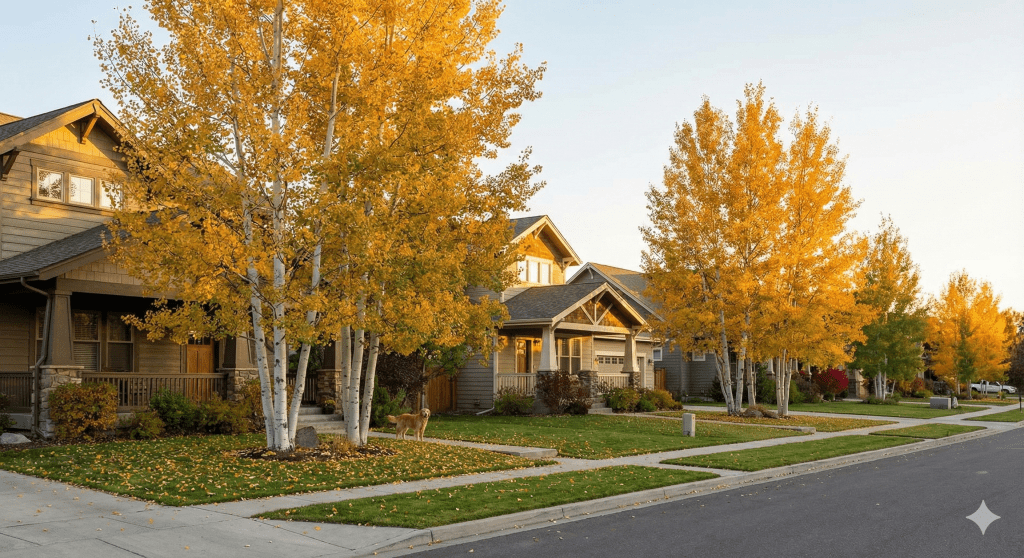
Aspen trees look like a perfect fit for mountain living—fast-growing, bright fall color, and “native” to Utah. Yet across the Wasatch Back—from Mountain Green and Morgan County to Summit County and Park City—Aspen routinely fails in residential landscapes.
The reason isn’t bad luck. It’s biology, site mismatch, and misunderstanding how Aspen actually survives in the wild.
If you’re considering planting Aspen—or wondering why yours is declining—here’s the straight explanation.
Aspen Is a Colony Species, Not a Yard Tree
Quaking Aspen (Populus tremuloides) is not designed to live as an isolated ornamental tree.
In nature:
- Aspen grows in large clonal colonies
- Individual trunks are short-lived
- Roots constantly send up new shoots to replace dying stems
In residential landscapes:
- Trees are planted individually
- Roots are constrained by lawns, irrigation lines, and hardscape
- Suckers are removed because they’re “messy”
When you stop the colony behavior, Aspen begins to fail—often within 10–20 years.
Irrigation Is One of the Biggest Killers
This surprises most homeowners.
Aspen does not want:
- Constant lawn irrigation
- Shallow, frequent watering
- Saturated soils near foundations
Along the Wasatch Back, Aspen is commonly planted:
- In turf
- Near sprinkler heads
- In compacted fill soils
This leads to:
- Root rot
- Fungal disease
- Structural weakness
- Premature dieback
Aspen prefers deep, infrequent moisture, not daily lawn watering.
Heat Stress at Lower Elevations
Aspen thrives in:
- Cooler mountain climates
- North-facing slopes
- Higher elevations with snowpack-driven moisture
Many Wasatch Back residential sites sit:
- On south- or west-facing slopes
- Near reflective surfaces
- At elevations lower than Aspen’s optimal range
Hot summers + reflected heat + irrigation stress = decline.
You’ll often see:
- Leaf scorch
- Sparse canopy
- Early fall color
- Dead upper limbs
These are not cosmetic issues—they’re stress signals.
Aspen Has a Short Lifespan in Landscapes
Even in ideal conditions:
- Individual Aspen trunks typically live 40–60 years
- In managed landscapes, failure often occurs much sooner
In residential settings along the Wasatch Back, it’s common to see:
- Significant decline by 15–25 years
- Structural failure during snow load events
- Sudden death after a few dry summers
This is normal Aspen behavior—but it’s rarely explained at planting time.
Disease and Pest Pressure Is Higher Near Homes
Aspen in residential areas faces stressors it doesn’t encounter in forests:
- Soil compaction from construction
- Mechanical damage
- Poor air circulation
- Heat island effects
Common issues include:
- Cytospora canker
- Marssonina leaf spot
- Bronze poplar borer
Stressed trees invite pests. Healthy colonies resist them.
Snow Load and Structural Failure
Along the Wasatch Back:
- Heavy, wet snow is common
- Aspen wood is relatively weak
- Poor structure from stressed growth increases breakage
We frequently see:
- Split trunks
- Sheared limbs
- Whole-tree failure near homes and fences
Aspen’s natural strategy is replacement through suckers—not holding structure over buildings.
Why Aspen Keeps Getting Planted Anyway
Aspen fails often—but keeps getting used because:
- It’s fast-growing
- It looks good young
- It’s marketed as “native”
- Nurseries sell what moves quickly
Unfortunately, fast early growth hides long-term failure.
Better Alternatives for the Wasatch Back
Depending on site conditions, better-performing options often include:
- Columnar or hybrid poplars (used selectively)
- Drought-tolerant evergreens
- Native or adapted shade trees with stronger structure
- Mixed plantings instead of single-species rows
The key is matching tree biology to residential reality, not mountain imagery.
When Aspen Can Work
Aspen can succeed if:
- Planted in large groves
- Allowed to sucker freely
- Given deep, infrequent watering
- Kept away from turf and structures
That setup is rare in typical residential lots.
Final Thought
Aspen doesn’t fail because homeowners are careless—it fails because it’s misused.
Along the Wasatch Back, Aspen is a poor long-term residential tree unless conditions closely mimic its natural environment. When it’s forced into lawns, tight spaces, and irrigated landscapes, decline is the predictable outcome.
Understanding this upfront saves money, frustration, and removal costs down the road.


 Tepeki
Leave a comment